Why Canvas Wall Art Elevates Your Home Decor
The Unique Texture and Aesthetic Appeal of Canvas Prints
Most homes rely too heavily on flat, glossy reproductions that seem to disappear into the wall. A canvas print changes that relationship entirely. The physical weave of the material catches light in subtle ways, creating a depth that standard paper cannot replicate. This texture adds a layer of tactility, inviting the eye to linger and explore.
A good canvas wall art piece also offers practical advantages that go beyond beauty. The absence of glass means no annoying glare, allowing the image to stay vibrant from any viewing angle. The material itself is robust, resisting wear and tear over time.
– This durability makes it a wise investment for busy households.
– It also fits the unique African sunlight, which can be harsh on traditional prints.
Ultimately, these canvases pictures bring a warm, organic feel to a space, making a house feel far more like a home. It is the difference between hanging a poster and installing a story. The visual weight is more grounded, giving rooms a sense of quiet confidence. That is the power of a textured finish.
Durability and Longevity Compared to Traditional Framed Photos
Traditional framed photos break, fade, and produce glare, sometimes all in one afternoon. These canvases pictures do none of that. There is no glass to shatter and no glossy surface to catch light. The fabric resists bumps, humidity, and South African sunlight without losing color.
I have seen a canvas panel survive a dropped toy and a moving truck! That is a field report, not a sales pitch.
Here is what durability means:
- Canvas corners resist cracking without needing reinforcement.
- A damp cloth cleans the surface without special products.
- The panel stays flat through seasonal humidity.
They remain intact and vivid for years. Meanwhile, a traditional framed photo needs repairs.
Versatility in Size and Shape for Any Room
A single canvas panel can make a 12 square meter bedroom feel intentional, while the same artwork transforms a long passageway into a gallery. This chameleon quality comes from size and shape flexibility. Instead of hunting for a frame that fits a strange wall, you order a canvas in almost any dimension. Vertical pieces suit stairwells and doorways. Horizontal panels anchor a sofa or headboard. Square canvases pictures work above a desk or in a compact bathroom.
Consider how a layout changes:
– A narrow 30 by 90 cm piece fills a gap between windows.
– A triptych divides a large wall without dominating it.
– An oversized square softens a stark open plan room.
For rental homes or frequent redecorators, this adaptability means your art moves with you, not against you.
Customization Options: Finishes, Edges, and Hanging Hardware
The back of a canvas hides the true craftsmanship. A gallery wrap with stapled edges versus a float frame with a mirror edge changes the entire illusion. You select the finish: matte for sunlight, satin for depth, gloss for vibrancy. I prefer matte in a Cape Town lounge.
Then, the hardware. A flimsy wire will let your canvases pictures sag. Use proper D-rings and a robust hanging system. Consider these options:
- Keyhole brackets for flush mounting
- Heavy-duty picture wire for large panels
- Z-clips for easy levelling
Each piece supports the weight without visible strain. Choose what fits your wall and your security. The right hardware makes your artwork feel permanent, almost alive.
How to Choose the Perfect Canvas Photo for Your Space
Evaluating Room Dimensions and Wall Space
Your wall space dictates the perfect canvas size more than your personal taste does. In South African homes, ceilings often run high, so measure from the skirting board to the cornice. For a single piece, the width should not exceed 75 percent of the furniture below it. Half of the wall’s height works for tall rooms.
Consider sight lines. The centre of your canvases pictures should sit at eye level, roughly 150 centimetres from the floor. A small piece above a large sofa leaves the wall feeling bare. Conversely, an oversized print in a narrow passage creates a cramped effect.
- Map the wall’s clear area, excluding windows and doors.
- Test proportions with kraft paper cut to size.
Use these measurements to avoid costly framing errors. I promise, the right dimensions transform ordinary spaces into deliberate interiors!
Matching Color Schemes and Interior Design Styles
Colour anchors a room. When selecting canvases pictures, pull hues from your existing palette. A bold abstract in ochre and rust enlivens a neutral grey lounge. For Cape Dutch interiors, consider botanical prints with muted greens.
Your interior style dictates the artwork’s character. Minimalist spaces favour clean lines and monochromatic pieces. Industrial lofts in Johannesburg respond well to high contrast black and white photography. Coastal homes near Durban gain depth from soft blues and sandy tones.
- Match the dominant colour in your cushions or rug.
- Use a complementary accent from your artwork to create visual tension.
- Let the frame, or lack thereof, align with your furniture finish.
Selecting the Right Image Resolution and Canvas Material
A pixelated canvas is a tragedy. Your eyes strain, your visitors squint, and that expensive print becomes a digital smudge. Resolution is the first thing to check. For large format canvases pictures, you want a file with at least 150 DPI at the actual printed size. Any lower and the image breaks apart.
- 40 cm x 40 cm: 1200 x 1200 pixels minimum
- 60 cm x 90 cm: 1800 x 2700 pixels
- 100 cm x 150 cm: 3000 x 4500 pixels
Material matters equally. Cotton canvas offers a fine, smooth surface for photographic portraits. Polyester blends handle bright South African light without fading as quickly. A matte finish reduces glare, which helps if that wall catches afternoon sun. Choose a material suited to the room’s lighting and the artwork’s subject.
Creative Display Ideas for Canvas Prints
Building a Gallery Wall with Mixed Sizes and Layouts
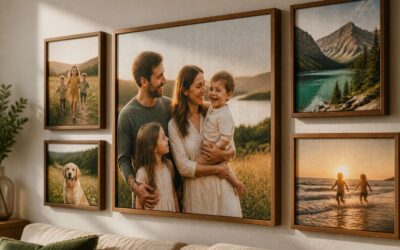
Cramming identical frames in a straight row is the default approach. A gallery wall of canvases pictures in varying dimensions changes a room’s feel. Start with the largest piece at eye level. Arrange smaller works around it in a loose arc. Visual balance matters more than perfect symmetry.
Spacing between each canvas should stay consistent. Gaps of 6 to 8 centimeters keep the arrangement cohesive. Mix orientations. A vertical canvas beside a horizontal one draws the eye across the wall. For a deliberate feel, lay pieces on the floor first. Test the layout before driving a single nail.
I favour a mix of layouts:
- Grid layouts suit narrow hallways and use uniform canvases.
- Organic arrangements work above a sofa or console table.
- Leaning canvases on a shelf adds a casual, changeable display.
The wall works as one composition, a single artwork made from individual canvases pictures.
Using Triptych and Multi-Panel Canvases for Visual Impact
A triptych changes how a room communicates. Three canvases pictures split one image into a sequence that pulls the viewer across the wall. Three separate images can also tell a story with a beginning, middle, and end.
Multi-panel displays work by breaking a flat image into rhythm. Gaps between panels become part of the artwork. Your eye fills those spaces. This suits South African homes with high ceilings, where a single large print might get lost.
Consider a landscape. A wide Karoo scene becomes three moments. I prefer odd numbers of panels here. The eye travels left to right across the panels. That movement is the impact.
Panels solve awkward wall proportions too. A narrow wall between two doors rarely fits a single frame. Two or three vertical canvases pictures slide in cleanly. They stretch the space upward without dominating it.
Positioning Above Furniture: Sofas, Beds, and Consoles
The wall above a sofa is prime real estate. The lower edge of the canvases pictures should float roughly fifteen centimeters above the backrest, forming a calm gap that lets the furniture breathe. Above a bed, the alignment follows the headboard, so a wide canvas or a balanced pair works best. Consoles are different. They sit low, so the artwork must rise higher to claim the wall.
- Sofas call for centered alignment with the seating, not the room.
- Beds ask for a lower edge that mirrors the headboard line.
- Consoles require taller or vertical canvases pictures to fill the empty wall above.
The result is a composition that feels intentional, not accidental.
Rotating Seasonal and Thematic Canvas Art
A wall is not a permanent statement. It can breathe, shift, and respond to the world around it. Rotating your canvases pictures is the simplest way to keep a room feeling alive without spending a cent. This practice turns a static decoration into a living part of your home.
Seasonal changes in South Africa are dramatic, from the golden Highveld summers to the wet, grey winters in the Cape. Your walls should reflect that shift. In summer, swap in bright, sun-drenched landscapes. When winter arrives, bring in warmer tones, rich textures, or moody abstract pieces. The change resets the entire energy of a room.
Thematic rotation works well for milestones and holidays, too:
1. Spring renewal themes with florals and soft pastels.
2. Festive seasons featuring warm, celebratory imagery.
3. Heritage Day pieces that celebrate local South African artists.
4. Personal milestones like a new home or a family anniversary.
The practical side is easy. Store off-season pieces flat in a dry space, wrapped in acid-free paper. Swap them during the seasonal change, when you already move your wardrobe and switch your linen. It takes ten minutes.
The result is a home that feels current and considered. Your canvases pictures become a rotation, not a fixture. They hold a conversation with your life as it changes, never letting the walls grow tired. A visual rotation keeps your environment honest, fresh, and entirely yours.
Incorporating Canvas Pieces into Home Office and Entryways
Your home office is where focus matters most. A well-chosen canvases pictures behind your monitor anchors your attention during long video calls. A muted landscape keeps the background calm without stealing focus.
The entryway works differently. It is the first thing you touch when you walk through the door. Lean a large canvas against the wall on a console instead of hanging it. This creates a casual, curated feel you can swap in seconds.
- A narrow vertical canvas beside the front door draws the eye upward.
- A small pair of canvases pictures on a shelf near the coat rack adds warmth.
- Layering a canvas against a mirror creates depth in tight spaces.
These rooms carry daily traffic. Choose pieces that survive the movement of bags, keys, and coffee mugs without showing wear.
Tips for Printing Your Own Pictures on Canvas
Preparing Digital Files: Resolution, Color Space, and File Types
I have seen canvases pictures ruined by a single overlooked setting. Resolution is the primary factor. A 300 DPI file at the final print size yields sharp edges, while upscaling a small file only creates new pixels and softens detail. The camera’s megapixel output determines whether the dimensions can be met at all.
Colour space requires equal attention. Adobe RGB captures a wider gamut, but most printers expect sRGB. For file types, a clear hierarchy exists:
- TIFF or PNG preserves every bit of detail
- JPEG works if quality is set to 10 or above
- BMP and GIF will not hold photographic tones
Soft proofing with the printer’s ICC profile reveals the final canvas appearance. A calibrated monitor supports accurate previews. A test strip on a small corner avoids wasting full canvases, allowing the colours to stay true to the original scene.
Understanding Crop Ratios and Safe Margins
When you frame a scene, you decide what belongs. The crop ratio determines what survives printing. Most cameras produce 3:2 or 4:3 files, while canvas frames demand 1:1, 5:4, or panoramas. Something must be cut. What do you choose to lose?
Safe margins matter because canvas wraps around wooden bars. The outer edge folds behind the frame. A face or horizon near the border gets pulled around the corner and out of sight.
The ratios I see most often:
- 3:2 for DSLR and mirrorless cameras
- 4:3 for Micro Four Thirds and most phones
- 1:1 for square canvases
- 5:4 for portrait layouts
When you order canvases pictures, the printing service provides a template showing the crop boundary and safe margin. The central zone holds the subjects. The edges serve as flexible space. The wrap will claim them. For canvases pictures, that loss is part of the format.
Choosing Between Glossy, Matte, and Satin Finishes
When you print your own canvases pictures, the finish becomes a dialogue with light. A glossy surface sharpens contrast, but it also catches glare. Matte flattens and soothes, yet it can mute the subtle depths of a shadow. Satin sits in between, offering a compromise that feels natural under most household lighting. I prefer satin for interiors because it reveals texture without shouting.
Before you choose, request sample swatches from your lab. Printed color shifts across materials, and what looks good on a monitor can feel chalky or sticky on canvas. Also, consider the room’s light source. A south-facing wall in Johannesburg will punish a high-gloss surface.
- Use a high-resolution file with minimal compression.
- Sharpen slightly for the canvas weave.
- Check the wrap edge for critical faces.
When handling canvases pictures, small decisions like these make the difference between a photo and a presence.
Avoiding Common Upload and Ordering Mistakes
The lab receives thousands of uploads each week, and most rejects share one trait: a file that looked fine on a phone screen. Upload systems often recompress your file, and a heavily compressed image will reveal every flaw once stretched over canvas weave. I have seen canvases pictures rejected for banding that no one noticed on a monitor.
Another frequent error is ordering from memory. You select the 40cm wrap, but the cart holds the 30cm version, and the difference appears only on arrival. Colour shifts also arrive without warning. A screenshot of a family photo carries no embedded profile, so the lab guesses, and greens turn brown. Check the order summary against the original receipt. Review the digital proof at full zoom. Many labs hold the proof for only 48 hours, and silence means approval.
The Personal Touch: Canvas Photo Gifts for Every Occasion
Milestone Celebrations: Weddings, Anniversaries, and Birthdays
Every anniversary cake fades, but the look on a couple’s face when they unwrap a canvas of their first dance stays. For weddings, anniversaries, and birthdays, canvases pictures carry weight that a bought item cannot match. I have seen a mother pause mid-laugh when she noticed a family portrait from her son’s wedding day, the cotton rag texture making that moment feel real.
Milestone celebrations need a lasting emblem. A canvas offers that permanence, a focal point for the room. Choose one of these personal tributes:
- A wedding day portrait, taken just after the vows.
- An anniversary image from the couple’s first holiday.
- A birthday photo of a child mid-laugh, cheeks stained with cake.
Each uses canvases pictures to preserve the exact seconds that mattered most. That is why we give.
Commemorative Canvases for Loved Ones and Pets
Fifty rand says there is a thousand photos in your phone you will never look at again. Print one onto a canvas and it changes how you remember it. My cousin sent me a canvases pictures print of her cat, whiskers dusted with flour from a baking accident. It hangs in her kitchen, a daily reminder of chaos and affection.
Commemorative canvases for loved ones and pets work best when they honour ordinary moments, not posed ones. A dog’s tired face after a long walk. A partner’s laugh caught mid-sentence. A child’s muddy knees.
- Grandparents holding hands on a bench.
- A horse nuzzling a favourite jacket.
- A sibling’s tired smile after moving house.
These canvases pictures carry memory into the present. They ask nothing of you except to be seen.
Family Portraits as Heartfelt Home Decor
In South Africa, the family portrait used to live in a heavy frame above the sideboard. Now it arrives wrapped in bubble wrap, a lightweight canvas that leans against the wall until you find the right hook. The personal touch turns a snapshot into a gift that keeps the moment close. A canvas print of grandparents with their grandchildren, shot in the Karoo at golden hour, carries more warmth than any store bought card.
Consider these occasions:
- A first birthday in Soweto, with the cake smash caught at the perfect angle.
- A graduation in Cape Town, gown still on, family gathered on the steps.
These canvases pictures become part of the home, displayed and lived with. They sit above the sofa in Melville or in a Durban beach house where the light hits the texture just right. Family portraits on canvas make the everyday feel significant. That is the real gift.
Maintenance and Care for Long-Lasting Canvas Art
Safe Cleaning Methods to Remove Dust and Stains
Dust accumulates silently, and the first visible sign arrives as a faded patch. I have seen canvases pictures lose their vibrancy within a year simply because owners never lifted a soft brush. Weekly prevention is the easiest fix.
For stains, resist the urge to rub. Dampen a microfiber cloth with lukewarm water and press it onto the mark. Lift straight up, repeat as needed.
- Always test on an inconspicuous corner.
- Never use soap or alcohol.
- Dry the area with a separate cloth.
These steps keep the surface intact. A gentle routine preserves the artwork’s depth and colour.
Protecting Your Canvas from UV Rays and Humidity
Sunlight is a quiet threat! South African summers pour intense UV through north facing windows, and that glow bleaches pigment layer by layer. I have seen canvases pictures lose their vibrancy in a single season when hung opposite untreated glass.
Humidity is the second danger. Coastal homes in Durban or Cape Town carry salt and moisture in the air. That combination settles into the weave and encourages warping.
Protect the artwork by keeping it out of direct light paths. Use UV filtering film on windows. Maintain a stable indoor climate.
- Position canvases pictures away from air conditioning vents
- Leave a gap between the frame and exterior walls
- Check the back for damp spots every few months
These habits cost little and extend the life of your art.
How to Fix a Sagging Canvas or Loose Frame
After a few humid seasons, the weave in many canvases pictures loses its initial tension. The surface begins to bow, and the frame corners separate slightly. I have watched this happen on pieces hung in coastal homes, where the nightly moisture change is relentless.
The correction is straightforward. If the stretcher bars have wooden keys, tap them gently with a mallet. Work a quarter turn on each corner, moving clockwise, until the ripples disappear. For frames without keys, insert thin shims between the frame and the stretcher to push the bars outward.
Check the mitre joints once the surface is taut. Open gaps mean the joint has failed. Apply PVA wood glue, then clamp the corner firmly for 24 hours. These small repairs stop a sagging canvas from slipping into permanent distortion!
When to Consider Re-Stretching or Re-printing
Long lasting canvas art depends on regular, gentle observation. Check the tension of your canvases pictures every quarter. Look at the surface from an angle to spot early ripples or subtle bowing. Feel the frame joints for movement. Catching small changes early prevents costly repairs later.
There comes a moment when maintenance turns into restoration. If the fabric has lost its give completely, or the printed surface shows fading or cracking that cleaning cannot solve, consider re-stretching or re-printing. Re-stretching preserves the original print if the canvas is still pliable. Re-printing offers a fresh start when the image itself has degraded.



0 Comments